




All About the Money
(Ireland, 95 min.)
Dir. Sinéad O’Shea
Prod. Sinéad O’Shea, Claire McCabe, Harry Vaughn, Katie Holly, Sigrid Dyekjær
Programme: World Cinema Documentary Competition (World premiere)
There’s a scene in Orson Welles’ film debut where the titular character Charles Foster Kane is being excoriated for how he’s running his newspaper. The inheritor of a vast fortune, Kane’s set on spending his money the way he chooses. His response exemplifies the mix of bravado and hubris that characterizes the man, retorting that if he’s operating at a loss of a million dollars a year, he’d have to close the place in sixty years.
I thought of Citizen Kane a lot while watching this remarkable film by Sinéad O’Shea (Blue Road: The Edna O’Brien Story). All About the Money provides a unique portrait into the life and proclivities of a spoiled son of the economic elite. James “Fergie” Chambers was born into privilege, connected to the vast Cox fortune that helped make his family one of the richest in the land. He’s directly related to James M. Cox, the newspaper man who exuded Kane-like energy as a governor and failed presidential candidate.
Fergie Chambers’ own politics as a self-avowed communist and political agitator lay an ocean to the left of his Democratic Party machine progenitors. The film begins by focussing on a Marxist/Leninist commune that he funds in the Berkshires. In a converted barn sits a gym and lecture room, where martial arts and philosophical treatises are taught in equal measure. Explicitly touted as a training ground for impending revolution, the community is made up of well-meaning individuals who survive on the largesse of their benefactor, spouting out dogmatic phrases that echo Soviet-era socialism without any sense of irony that their position of servitude sits at the whims of the man funding their room and board.
Shot over a multi-year period, O’Shea is granted unique access to Chambers through many phases of his life, from his enthusiastic support of the compound’s construction, through to his eventual abandonment of the project in favour of other interests. Festooned with tattoos that speak to his ideological bent, including many Russian and Soviet iconographic elements, his dilettante approach to real questions of justice, morality and political action are made that much more trivial given how little stake he has in any game given his enormous personal wealth.
Chambers’ tale is most engaging when there’s overt recognition of this paradoxical situation. His discussion about how he can spend millions and millions and then without any effort whatsoever rebuild his nest egg through even conservative investments illustrates effectively how American generational wealth can be fostered, while equally demonstrating how the very forces that have prevented other community members from sharing this benefit have an economy rigged against them.
Following the events of October 7th, we see Chambers’ politics turn even more radical. His social posts aggrandize the murder of Israelis and call for a continuation of the so-called Global Intifada. Naturally, such sentiments are not unique to Chambers, and the ideas are echoed by some of the more gormless members of his retinue. However, when actual action results in the arrest of a key member of the community, the wealthy patron does whatever people have done traditionally in these situations and finds refuge in a place without an extradition treaty.
Finding home and a new religion in Tunisia, the film briefly provides a glimpse of humility from the man, a sense of real longing for a better way forward. Islam, for Chambers, exposes as another philosophical plaything like his advocacy for communist revolution, the hypocrisies ignored and self-sacrifice required rebuked in favour of cosplaying a convert. He eventually invests in a local football club, gaining adoration while the masses chant anti-Jewish screeds and hold up massive banners championing the head of Hamas to Chambers’ own glee.
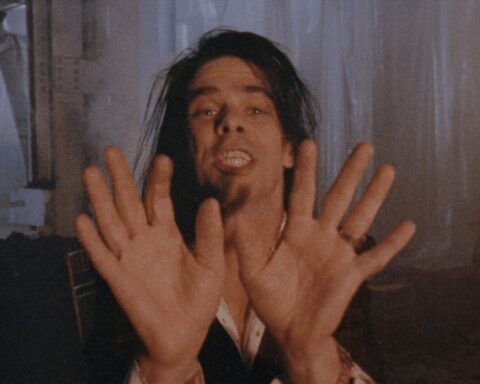
We hear about rather than witness Chambers’ most manic episodes that take place in North Africa. When O’Shea reconnects with him, they meet in a fancy Irish hotel room. The window overlooks the street in what’s presumably a non-smoking room as Chambers hangs his hand out to try and make a gesture of abiding by rules that don’t really apply to men of his wealth. This is the almost broken man that serves as the film’s beginning and introduction to the closing chapter, an attempt through the interview process to make sense of his traumas that may have led to his current state.
Naturally, this too passes, and in a well-designed kitchen, we finally witness a domestic life that’s as commonplace as any, far removed from promises of revolution, removed from the cheering crowds at a football station, and merely the connection with the daughter of a famous artist back with her errant partner raising their young child.
The final title card talks of Chambers trying to buy the film outright and prevent its showing, a final indicator perhaps that money can’t buy everything. Yet this half-assed attempt is indicative of such a patently ridiculous man, one who is gifted with immense financial opportunities to do what he wants, but doomed to fail due to his bleakly comical inability to make intelligent decisions or to parse complex topics in any meaningful way. Being pathologically dumb and politically obtuse doesn’t matter when you’re rich like he is, as Chambers’ power comes from money that doesn’t care about ability or fairness.
We see that for all his empty rhetoric, hateful demeanour, and self-aggrandizing pronouncements, Fergie is an empty chamber, filled with little more than half-understood ideas expressed with half-baked platitudes. Yet while Kane’s tragic flaws left him alone among his vast accumulations, there’s little to suggest that Chambers can’t continue to fail without worry, with his personal wealth a safety net of the strongest variety that has shielded such individuals since medieval times.
All around the world there are people like Chambers, be they presidents, princes, techbros, or socialites. As O’Shea’s film presents, there’s a deep emptiness within their lives, but this isn’t a flaw per se but a feature, keeping them from truly needing to come to terms with their own faults and humanity. For all this talk about shared responsibility, communal living, and shared wealth, this man shows that there’s nothing like being the centre of attention thanks his own perceived largesse. For Fergie Chambers and many like him, it truly is All About the Money. The rest of the nonsense, from the ideology to the faith to the sense of justice, merely serves as the cost of doing business while moving on to the next shiny thing.