



You Can See Everything
(USA, 174 min.)
Dir. Nathan Fielder, Lance Oppenheim
Prod. Nathan Fielder, Lance Oppenheim, Tatiana Bears, Maggie Ambrose, Jack Davis
It’s always tricky when one’s ability to believe a situation hinges upon the credibility of the New York Times. The once-esteemed publication plays a pivotal role in You Can See Everything. Entrepreneur and convicted felon Elizabeth Holmes finds herself handcuffed by the Times’ habit for playing fast and loose with sources, quotes, and context. Holmes and her husband, Billy Evans, meticulously check the quotes in Amy Chozick’s 2023 profile “Liz Holmes Wants You to Forget about Elizabeth.” The couple stops when they get to a line they feel reads completely off.
Holmes—in the article, anyways—talks about the dramatic takes on her story about becoming a self-made billionaire through her health technology company Theranos, which purported to have a miracle device that would revolutionize blood tests. However, in shows that tell the Holmes story, like the 2022 Hulu mini-series The Dropout, starring Amanda Seyfried in an Emmy and Golden Globe winning performance, the entrepreneur doesn’t really see herself in the portrayals. “They’re not playing me. They’re playing a character I created,” the article quotes Holmes as saying.
The line niggles at Holmes and Evans. They tell filmmaker/funnyman Nathan Fielder that the soundbite seems out of character. They can’t recall Elizabeth saying it during the interview, especially the “I created” part. Moreover, they insist that they can prove it because they recorded the conversation.
Fielder, who serves as a constant on-camera presence throughout You Can See Everything, provides a perfectly rational response. He suggests they check with the journalist to verify her quote. She stands by the reporting, but doesn’t offer receipts. Holmes and Evans stick to their guns, but they, too, fail to deliver evidence that the line wasn’t part of the interview.
Thus ensues a stand-off that sits at the heart of You Can See Everything. Fielder finds himself at the centre of an argument in which both parties of a recorded conversation have completely different accounts of what transpired and can’t—or won’t—substantiate either claim. Moreover, Holmes and Evans imply that Chozick embellished the quote by extending it with two words. Which side one believes ultimately sways one’s entire reading of the Holmes situation: She’s either a self-made enigma or the victim of a collective pile-on. The Elizabeth Holmes story conjures a maelstrom of secrets and lies, deceptions and revelations, and untruths and creative liberties. It also includes earnest pleas for empathy and understanding. But everything depends upon what one chooses to believe.
Belief is a choice in this generational masterpiece by Fielder and the almost always offscreen director Lance Oppenheim (Some Kind of Heaven). You Can See Everything is a film that will be debated, dissected, studied, copied, and imitated, but never repeated. It interrogates the foundations of human interaction, the contracts of documentary filmmaking, and the integrity and fallacy of objective reporting in one hugely entertaining shape-shifter of a movie.
It helps in that few films enjoy a subject as elusively slippery as Holmes. She genuinely wants to convince Fielder of her innocence. There are many persuasive moments throughout the time they spend together in the 34 days leading up to her surrender to begin her 11-and-a-half-years prison sentence for defrauding investors. And yet Fielder begins the project by approaching his accomplice as a fraud thanks to the exorbitant amount of media coverage—and criminal charges—positioning her as such. How does one find verity in a proven liar?
However, leave it to a documentary to prove that the truth isn’t nearly as interesting as a lie. Fielder runs with Holmes’ apparent cognitive dissonance between her perception of reality and that of people around her. He engages in one head-spinning conversation after another with her. Holmes explains her side of the story and her accounts often follow convoluted logic. Semantic acrobatics provide daily mental workouts. Statements make perfect sense to hear as she elucidates her innocence. Fielder, meanwhile, finds himself caught in a remake of Abbott and Costello’s famed “Who’s on first?” bit.
Fielder actually makes Holmes watch the iconic comedy routine to stress the point. In quite possibly the best documentary scene in nearly a decade, Fielder observes in utter amazement—opened-jawed awe, perhaps—as Holmes takes in the scene purportedly for the first time. She doesn’t get it. The more Fielder tries to explain the punchline, Holmes can’t quite connect his take on “Who’s on First?” with her own. She’s just thinks it’s two guys talking over each other. The head-spinning scene makes one’s brain hurt, but brilliantly exemplifies the quagmire in which Fielder finds himself.
Little adds up and there are red flags everywhere. For one, Fielder comes to the project as a work for hire. He explains over the course of the film that Holmes and Evans pitched him the project. But Holmes especially shows no real awareness of Fielder’s work on series like Nathan for You and The Rehearsal. It’s pretty bold that they supposedly approved a director with relatively limited experience in conventional documentaries, but robust work in comedic documentary-ish series in which deception is part of the dramatic design. They’re either walking into a trap or setting it, but it’s up to Fielder to deduce that dynamic.
It gets especially complicated with Evans. For a project that claims to emphasize Holmes’ voice, Elizabeth often speaks at a remove. Evans frequently responds for his wife. When she answers, her cautiously complex phrasing suggest a high degree of coaching. Evans also micromanages Fielder and the film crew, interrupting interviews and sometimes outright shutting them down. But he welcomes the camera to tag along when he hits the gym. There’s even a completely random shot of him brushing his teeth in the shower with his gigantic penis hanging out for Fielder to make a star of the show. (You really can see everything in the Holmes’ household.) If only Fielder included some notes on who ordered the shot, the mystery of You Can See Everything might be halfway solved.
Every conversation plays and replays in his mind like that New York Times story. As he lurks in the corners, recording exchanges between Holmes and Evans, nothing sits well with him. Long lenses capture the action at a remove. The voyeuristic design plants seeds of doubt in one’s mind, as Holmes and Evans seemingly behave differently when the directors’ are out of sight. But one has to mull some scenes over to decide if their comportment changes at all. The film illustrates how the slightest inflection, gesture, twitch, or tonal shift can completely reframe a conversation in retrospect. It’s especially complicated when the central subject disputes whether she’s a “character” of her own creation.
All that Fielder can really do, then, is test that hypothesis. When Holmes finally goes to the slammer and the filmmakers’ relationship with Evans becomes especially fraught, their incredible access becomes limited at best. You Can See Everything therefore goes to the catalyst for that disputed Times quote.
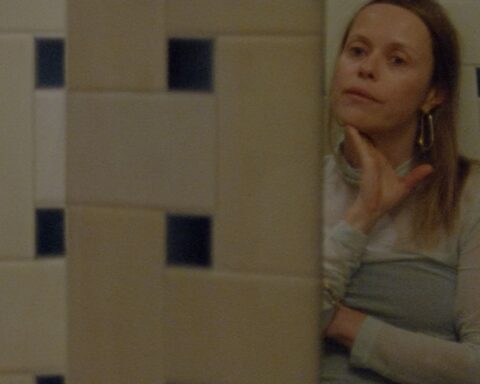
The filmmakers visit Seyfried herself to learn about what it’s like to get inside Holmes’ head. The actress, who lives on a ranch with a farting horse, admits that she couldn’t access Holmes directly while making The Dropout, but extensively researched her in interviews and video of her deposition. She’s pored over everything, and Fielder and Oppenheim let her preview their footage from their time with Holmes. Seyfried provides insights and observations, but also interpretations based upon her professional experience of putting herself in Holmes’ psychology.
The film creates an altogether new dynamic in non-fiction filmmaking as the directors recruit Seyfried to explore and interpret the fissures of Holmes’ story. The doc tests Holmes’ assertion that the “character” is not one of her creation by inviting Seyfried to inhabit that role again. Fielder scripts exchanges with Holmes that went unrecorded. He workshops them with Seyfried and the filmmakers record them as dramatic interpretations. One can’t really call them re-enactments, however, as the nature of their communication means that Fielder plays everything out by memory. One revelation after another further twists the story, and it takes a dramatic gamble to discern how much one can disentangle truth from fiction in the ostensibly objective “documentary” scenes at Holmes and Evans’ beach house.
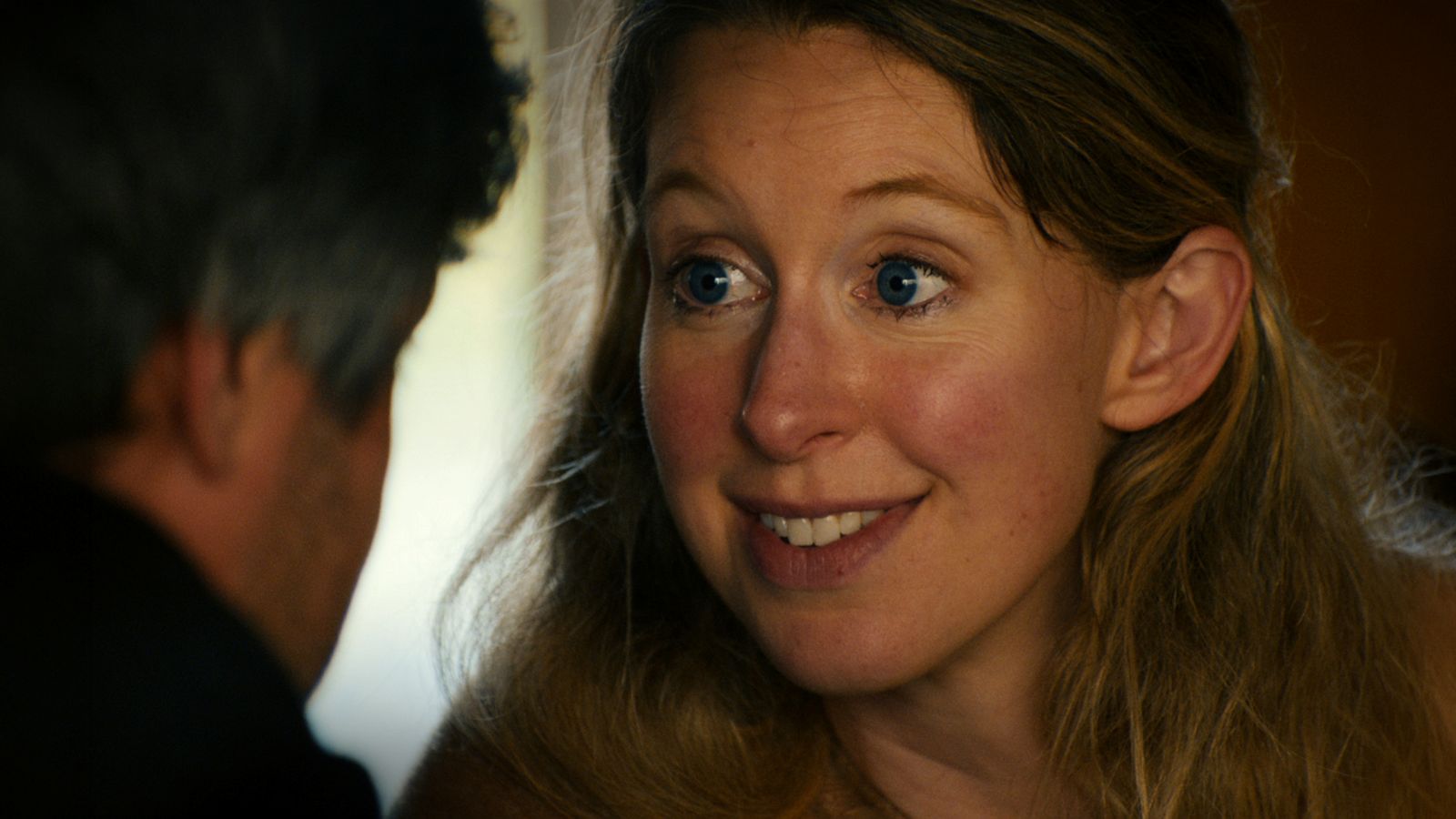
Seyfried’s placebo Holmes takes You Can See Everything to another level. On one hand, getting the real deal paired with a dramatic interpretation in the same film lets one observe how eerily accurate Seyfried captures not simply Holmes’ voice, but also her wide-eyed earnestness. But Seyfried’s creative takes on the script frame the Holmes’ portrait anew, as we’re getting Elizabeth via Fielder via Seyfried. The film asks audiences where the broken telephone games begins while telling a story, but also where the fabrication originates if it starts with the source. Much like Alex Gibney’s avatar of Elon Musk, Seyfried’s empathetic Elizabeth Holmes often plays like the most authentically reliable source, even if she’s a feat of creative license. You Can See Everything seeks truth through performance and, in doing so, further pushes viewers into new boundaries that challenge their relationship to the people they encounter through the screen and their complicity in the narratives that take shape around them.
Like that New York Times reporter who may have remember a quote accurately, flubbed it, or fabricated it entirely, You Can See Everything interrogates Holmes by making her a character of its creation. Or they honour her creative vision if they’re on the level. Take your pick. They’re equally juicy characters in this deadpan funny and jaw-dropping puzzle that makes a viewer question everything.