



London
(Austria, 122 min.)
Dir. Sebastian Brameshuber
Prod. David Bohun, Lixi Frank
Program: Wavelengths (North American premiere)
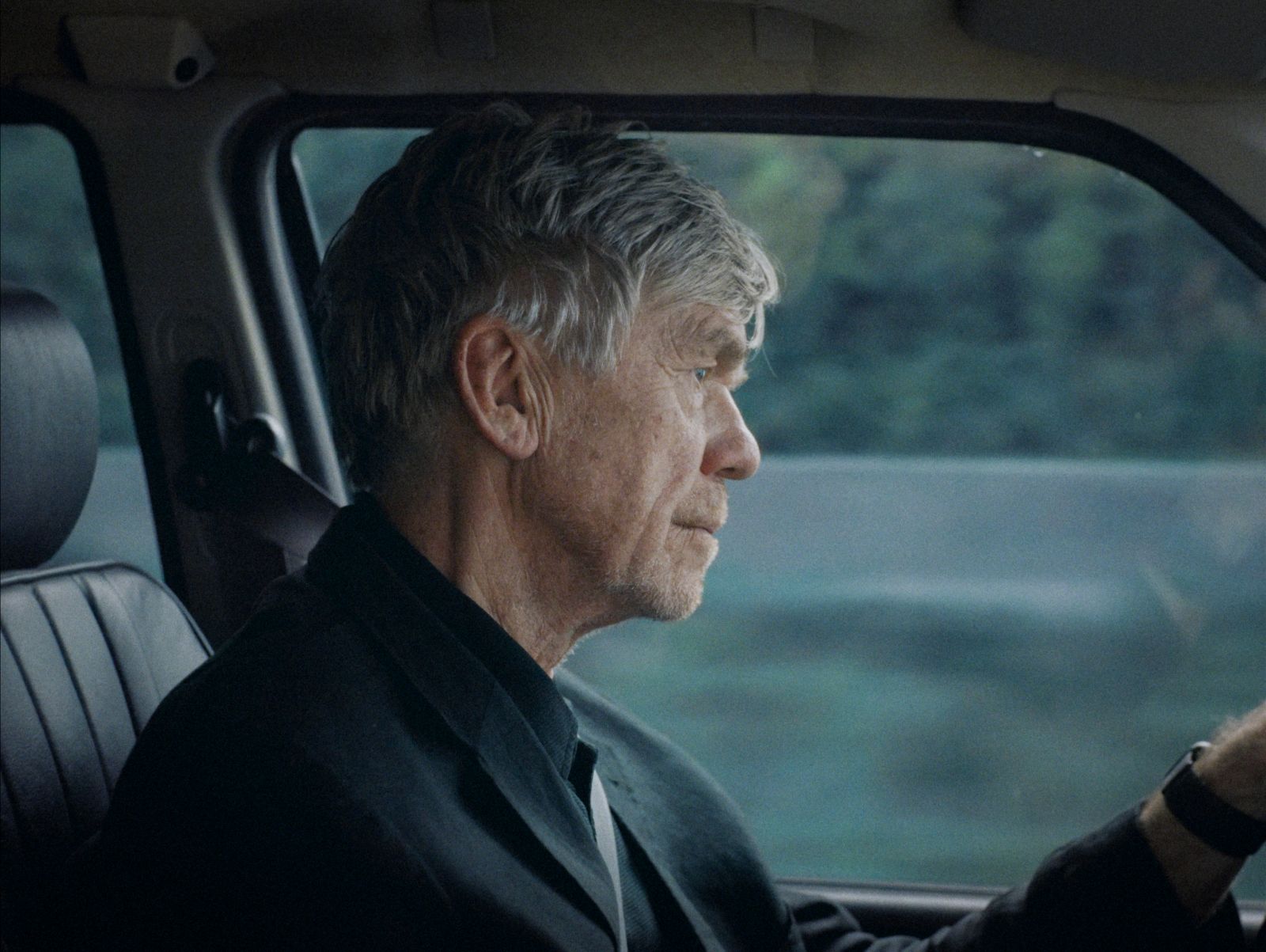
The winner of the Grand Prix at this year’s Cinema du Reel documentary festival in Paris, Sebastian Brameshuber’s London isn’t exactly a doc, nor does it take place in London. Using a cast of non-professional actors who may or may not be playing themselves—their names are real—the director has created a road film that wasn’t shot on a highway. Although we see Austria’s famous West Autobahn throughout the film, Brameshuber and his crew used rear projection to replicate the feel of the road. What we see in London is a hybrid documentary: it’s a staged drama shot mainly in a studio in which stories—presumably real—are shared by people sitting in a car.
The film concentrates on Bobby Sommer, a retired museum guard and musician who travels constantly to Salzburg from Vienna, a trip of 350 km which takes over three hours, to visit his old friend Arthur in his hospital bed. Out of boredom and as a means of economizing, Bobby takes passengers with him who pay for gas. Over the course of the film, he drives ten people—half women, half men—some all of the way and others only as far as they want to go. The conversations in the car go similarly to the trips: there are vivid lengthy exchanges and short ineffective ones.
A concern about warfare and the perilous state of events in central Europe hangs over the film. Polina Skomorokhova, a Ukrainian born psychotherapist, tells Bobby that Kiev is only a four-day drive from Vienna, and we hear an interview on the radio dealing with the preparedness of the Austrian military in case of emergency. Although the film stays on the road between Salzburg and Vienna, the outer world is ever present. Lana, born in Croatia but who lived in parts of the former Yugoslavia before arriving in Austria, is a gay activist whose family won’t be attending her upcoming marriage. Cliff, a Nigerian who has appeared in earlier Brameshuber films, reveals that he never saw his father again after he fled his home country over 20 years ago.
Travelling on the road together enforces a peculiar intimacy. Although Bobby isn’t a trained interviewer or psychologist, he is a fine listener. Jon, an Albanian theoretical Communist, expounds on his theory that Avatar is actually a brilliant Marxist takedown of imperialism in which the planet’s Indigenous population beat the colonizing force from the Earth. Ted, a very nerdy Austrian, is fascinated by the Nazi vision that created the Autobahn including its bridges and views. Bobby is always ready to hear the ideas of his passengers and never gets upset, nor does he necessarily endorse their ideologies.
Brameshuber is clearly besotted by cinema. Not only does he reference Avatar, but he also gives Bobby a big speech in which he evokes The Third Man, the extraordinary thriller set in post-war Vienna which stars Orson Welles in his iconic film role as black marketer Harry Lime. As a film, London evokes the master of car-driven dramas, Abbas Kirarostami (Taste of Cherry, Ten) and such wonderful landscape experimentalists as James Benning and Bette Gordon (United States of America) and David Easteal (The Plains).
Behind the experimentation, cinematic homages and political discourse in the film is a beating heart of gay love and solidarity. Bobby’s friend Arthur is in a coma throughout much of the film, but he continues to make the long journey to Salzburg to be with him. And the film is bookended by Bobby’s evolving friendship with Paul, who goes from being an unhappy soldier to a young man on the run from the authorities, needing help to escape Austria.
The most beautiful passage in London takes place after Bobby is told that Arthur is gone. He goes back to drive his car and through the rear projection, we see the highway receding in the fog. The soundtrack plays the haunting Lou Reed song “Pale Blue Eyes” as Bobby’s emotions linger on his best friend.