



Simon Plouffe’s Cranes and Voices (Des grues et des voix), which premieres at RIDM, begins with a montage of sounds and speakers as spaces and objects are rendered through variation in tones and rhythms. The sequence sets the tone for an unusual documentary that connects “hearing voices” with the rise of gentrification in Montreal. Director Plouffe explains that the project emerged because he wanted to make a movie about sound, an ongoing obsession in his work. During his research, he came across the work of American scientist Harold Burris-Meyer, whose pioneering studies of sound transformed theatre but also psychological warfare.
“You know in Apocalypse Now,” says Plouffe, “that scene with the speakers on the helicopters that’s used to terrorize the population? That’s a bit of him.” Plouffe’s filmmaking has always been deeply invested in sound and this film continues the aesthetic but also social-cultural examination of the subject.
Plouffe’s film suggests the duality of sound as a balm and as a weapon. He was especially interested in how sound can be used to manipulate the masses. The documentary opens with a quote by Burris-Meyer: “The power of sound lies in its ability to penetrate barriers physical, psychological, and emotional,” which operates as an overarching thesis that ties together the film’s disparate parts. At one point, the film was going to feature recreations to bring his work to life, an idea that Plouffe later abandoned. “It would have been an entirely different kind of film,” he says.
Plouffe’s research on sound lead him to meeting with Hubert Gendron-Blais, an author, musician, and activist who founded the collective Réverbérations d’une crise en cours, a community-run organization in Montreal that investigates the conditions of the housing crisis through sonic inquiry. Rather than an individual portrait, however, Cranes and Voices embraces plurality in its approach to its subject. Perhaps indebted to the collectivist filmmakers of the Soviet avant-garde, the community rises above the individual.
Gendron-Blais also eventually inspired Plouffe to meet Philippe-Aubert Gauthier, whose groundbreaking research at UQAM (Université du québec à montréal) and Université de Sherbrooke uses a sound and voice simulator to help students in social work and medicine better understand the experience of “hearing voices.” As Plouffe explains, most people have a lot of misapprehensions about what that means. It’s not just psychiatric disorders that lead people to experience “auditory hallucinations.” Some people only experience it during parts of their lives due to high stress or grief. The shape and conditions of our environment can also have a large impact on what types of voices we hear. Up to 10% of the population hears voices.
“To better understand what it means to hear voices,” explains Plouffe, “I had to live it.” The director says he spent a lot of time working in the sound simulator with the technicians, who are also artists. The process also involved lengthy discussions with people who experience auditory hallucinations, who help shape the textures, tones, and vibrations of the aural project. “A lot of it is very subtle,” says Plouffe, “it’s all about perception.” The film’s sound design toys with the viewers’ perception, inviting them to question what they hear and how. In his approach to bringing the audience into that experience and in an attempt to subvert clichés, Plouffe avoided the more violent voices, preferring something a little more subtle.
On the surface, the relationship between the two ideas in the film, auditory hallucinations and gentrification, aren’t obvious. However, as the movie progresses, they become more deeply intertwined. Plouffe discusses how the transformation of neighbourhoods drives out old residents; the constant noise of construction and destruction has a profound psychological impact on residents. “It creates a lot of anxiety and exacerbates mental health issues that might already be present,” he says. On top of that, Plouffe feels that the impact of the noise can have a similarly troubling effect on the health of people. The low-level stress associated with a lack of perceived comfort and safety is not unlike the experience of hearing auditory hallucinations.
“People who hear voices often feel like they’ve lost control of their body,” says Plouffe. “Those who are surviving during a housing crisis who no longer feel at home in their own houses feel similarly. They’re never quite right anymore. I saw a way of linking this social problem where people are forced from their homes and are increasingly isolated to a bigger mental health problem.” Rather than treating his subjects as individuals, Plouffe’s filmmaking positions sound as a condition of social concern. The film’s sound design becomes integral in creating harmony and discord within this collectivist approach. Sound, music, voice, and noise create a landscape that suggests new ways of “seeing.”
Plouffe speculates that making a documentary that’s more of a classical portrait would have likely been easier, but ultimately he sees this film and his other work as a plea towards collective action. “Where there is a collective that organizes to create something, it functions in a way that tangibly impacts people’s lives. We no longer feel alone; we are no longer alone in our heads with our anxiety,” he says. “We feel stronger and stronger. It allows us to see more clearly and also advance. It’s through collective action that we can make changes during a crisis.”
The film nonetheless does have a narrator of a sort, Serge. One of the people that Plouffe worked with who does hear voices, Serge’s own voice carries throughout the film. He is a kind of observer and interlocutor who shapes our perception of the city. “For the film but also as part of the voice simulator, Serge is a bit of a co-creator, I’d say,” says Plouffe. Through Serge, we better understand what it means to navigate the world with voices. “I wanted to make it more sensible and visible without being too dramatic. I wanted to show that it’s possible to live with these voices even though it can be very difficult and sometimes very intense,” says Plouffe.
While the film crafts an environment of noise and voices, it doesn’t privilege silence, either. Plouffe explains that the lack of noise isn’t the solution. Oftentimes, the end goal of gentrification is an antiseptic view of sound. He points to the richest neighbourhoods in Montreal, which tend to have the strictest bylaws against sound.
Conversely, in Montreal, the most popular neighbourhoods tend to be the noisiest ones. He cites the example of a popular music venue, Le Divan Orange, closing due to noise complaints. “It’s maybe another subject, but there’s enormous pressure on venue spaces and the entertainment districts to be quieter, pushing out all life.” There is a strong link between the social life of a neighbourhood and the people who inhabit it.
“We see how there’s this push to have big properties for people, often without kids, that really privileges tranquility. They take up a lot of space and are encroaching on the few public spaces we have,” says Plouffe. To quote Hubert [Gendron-Blais], says Plouffe, “the sound of gentrification is silence.” When the construction stops, so does public life.
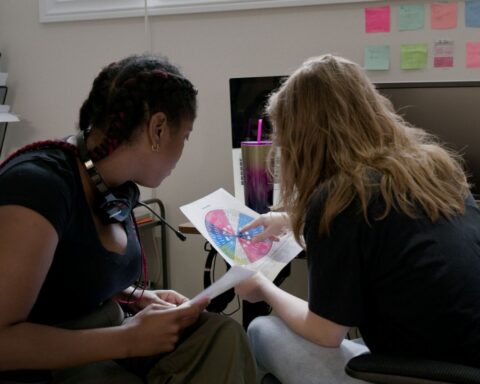
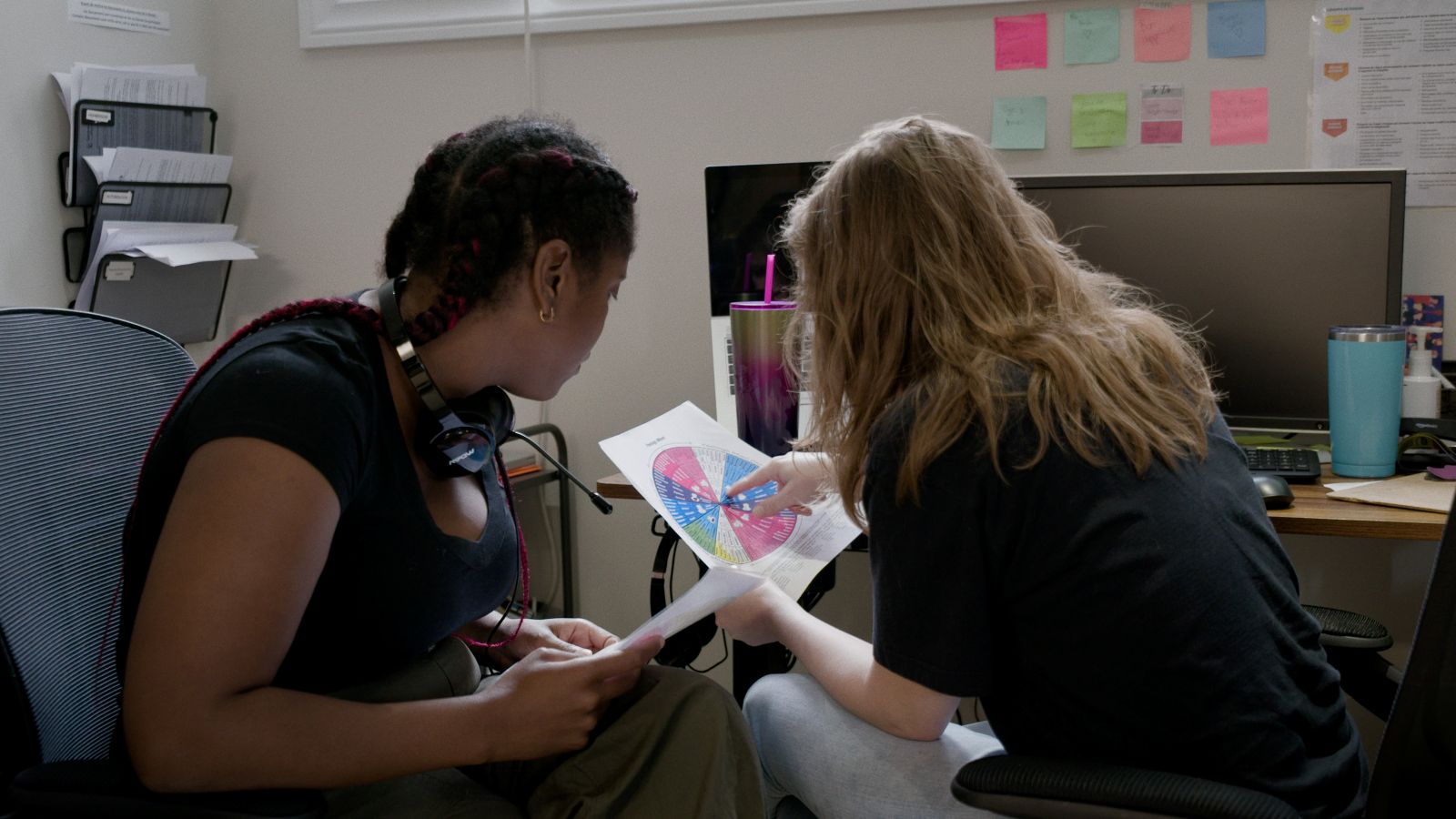
Sound informs more than just the film’s audio identity within the film but also, in many cases, the image. Small sequences that blur the line between fiction and nonfiction feel shaped by our understanding of sound. In one sequence set during a workshop, images are overlaid and edited into a blur of faces, ideas, and movements. The sequence acts as a way of truncating work but also has the effect of visualizing the way sound works compared to the image, layered one on top of the other. It also helps visualize the ways in which new ideas and actions are born through the building of conversations and collective action to create something new.
For Plouffe, sound guides all his work: it’s never an afterthought and the film shapes itself from his relationship to the sound. “I am fine with an image being in 2D but sound is always in 3D for me,” Plouffe says. For him, sound allows viewers to step into spaces. “Through sound,” he says, “we are able to reach something even more real, even if it’s still not quite reality.” He’s not sure how well Cranes and Voices works on a smaller screen, as the sound was designed using Atmos – a 3D audio technology. In a cinema equipped with Atmos, it envelops and surrounds the viewer. “I don’t see it as a technical gimmick, but as a way to immerse the viewer in the auditory hallucinations,” he explains. “There are subtle moments in the sound design where it might make the viewer turn their head a little.”
Though rooted in social activism, Cranes and Voices maintains an element of the magical. The film moves towards a final sequence that challenges our visual and audio perception. Built in studio and painstakingly created in post-production, just as we think we’ve gained our footing, the sequence challenges everything that came before it. “It’s a kind of madness, something that shifts us away from the real,” says Plouffe, “but then again, maybe it is real — at least for some people.”
Cranes and Voices premieres at RIDM 2026.
Please check your local listings for additional festivals, event screenings, and broadcast dates.