



Ghost in the Machine
(USA, 110 min.)
Dir./Prod. Valerie Veatch
Programme: Next (World premiere)
Back in 1949, celebrated Oxford philosopher Gilbert Ryle published his seminal work, The Concept of Mind. Broadly speaking, this epistemologically dense text challenges Cartesian dualism, the notion that the mind is separate from the body, with the soul or spirit of cognition existing apart from the biological operations of the body. Ryle refuted this divide, somewhat sardonically referring to it as a “ghost in the machine,” and writing in dismissive ways about the myth propagated by post-Cartesians that solidified the divide between cognitive results and the mechanisms from which they are born.
Ryle’s term, which gives Valerie Veatch’s stimulating and deeply intellectual film its title, has developed a more insidious or macabre meaning. It now connotes the notion that within a given system, there’s a rot or a haunting, something endemic to the process whereby the results are shaped by the inherent sickness like a cancer. This broad understanding of the term (while still explicitly evoking the works of Ryle, among others) makes Veatch’s polemical philosophizing about the development of so-called “Artificial Intelligence” so timely and provocative.
Through a series of interviews with data scientists, philosophers, cultural critics, and historians, and told through a series of chapters that tackle the topic in increasing depth, Veatch ties the development of large language models, machine learning, and other technologies at the forefront of science and economy in the present to some truly insidious beginnings that, according to many of the interviewees, demonstrate inherent concerns about the state of things.
Veatch begins her film by showcasing the case of Tay, the AI-powered chatbot that Microsoft launched on Twitter back in 2016. The idea of having a system with which one can use human language to converse is commonplace a decade later, but back then it was groundbreaking. Schooled on millions of actual online interactions, the chatbot was a reflection of real-world conversations and, unsurprisingly, that’s where things went almost comically wrong. Within minutes of launch, Tay’s responses to challenging queries were exposed as anti-Semitic drivel, and with her celebration of Hitler and other more fascist missives, the plug was soon pulled.
From here, Veatch looks back to some of the intellectual and social foundations that spurned the basis for the Silicon Valley revolution. She tyies it explicitly to early 20th century eugenic proposals, as well as early phrenological concepts that claimed racial and gender superiority for a given class (white men, mostly) and advocating for sterilization of people perceived to be detrimental or damaging to this notion of purity. These American-born ideas would, of course, flourish to its most fanatic form in Nazi Germany, but as Veatch’s film posits, the foundational tools for these abhorrent policies, notably notions of statistical analysis and generative heuristics, are the exact foundations that drive what is commonly described as AI.
Veatch and her interviewees touch upon certain key leaders in the world known to millions, such Elon Musk to Sam Altman, but also some of the lesser-known figures who helped birth the current generation of venture capitalists, techno-futurists, and others. While the film does delve into some of the darker recesses, it’s not overtly political in a party sense, and major figures such as Peter Theil, or even the connection to South African Apartheid policies, are outside the scope of what’s a fairly damning indictment of the Standford-area tech-bro ethos.
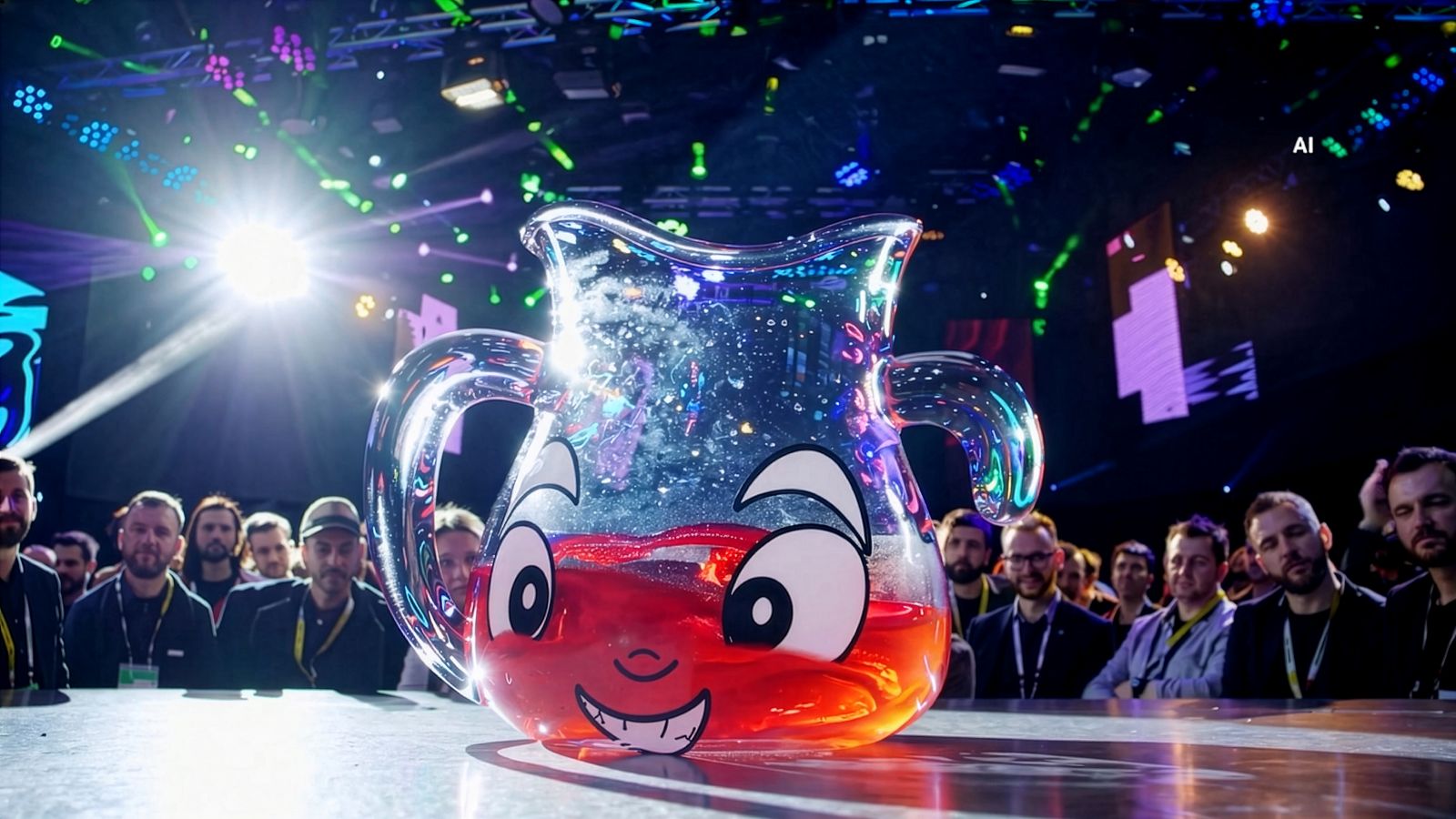
A small disclaimer on the upper-right corner of the screen designates “not-AI” for much of the film, but as the chapters develop, and more B-roll replaces the straightforward Zoom-call like interviews, a slew of AI videos, much of it sloppy with oddly drawn fingers and mispositioned feet, are overtly designated as such. It’s a clever gambit if a slightly distracting one that forces viewers to accept the filmmaker’s indications about the veracity of one image over an other, while repeatedly reminding them how tenuous such interpretations are becoming thanks to contemporary tools.
In a step too far, Veatch also chooses to editorialize with strange sound editing. Key phrases from a given clip repeat with a downward pitch, giving an ominous, almost diabolical sound, a voice for that ghost that she and others are trying to expose from within the seemingly innocuous statements. Done sparingly, it would have been more effective, but the decision soon becomes more tedious than anything, needlessly making overt that which any engaged audience member would already be picking up.
The film itself is incredibly ambitious in terms of its intellectual scope, but its effectiveness would be buttressed by a bit more concision. Some of the more tenuous claims are repeated multiple times without even the semblance of counterargument, making this feel at times more of a preaching to a choir than a true engagement with what are inherently challenging political, social, and philosophical concerns. On the other hand, dipping into other topics worthy of deeper explorations, especially the very human role in taming AI systems, namely those in English-speaking African nations, gives a sense that the film is paradoxically too wide in scope and only scratching the surface when it comes to the multifarious issues evoked by this current technological movement.
In the end, Veatch’s film carves out an important space, one that takes seriously the current state of things while asking important questions about what’s to be gleaned from these tools at our disposal. The film works at its best not when answers seem easy to come by, but when it further complicates the conversation itself, showing that simplistic admonishments (à la the inane and ineffective “fuck AI” mantra) do little to expose the deep challenges that such a technological revolution can generate. At the same time, the correlation between insidious techniques and procedures does not inherently doom the result—the question of whether the techniques of generating evil can be rewired to provide good is itself a query for the ages.
Ghost in the Machine is in many ways a perfect film of the age – messy, argumentative, grasping at answers in what feels to be a state of deep uncertainty. While it may not deliver a desired catharsis for anyone on the periphery of these radical changes to our technological capacities, it gives us something far more required. By collecting these thinkers in one place, providing an accessible yet deeply intellectual forum for raising questions of this sort, Veatch elicits her own mode of generative information, giving rapt audiences some tools to explore these deeper queries, and some starting points to make more profound sense of where we stand during these tumultuous times.