


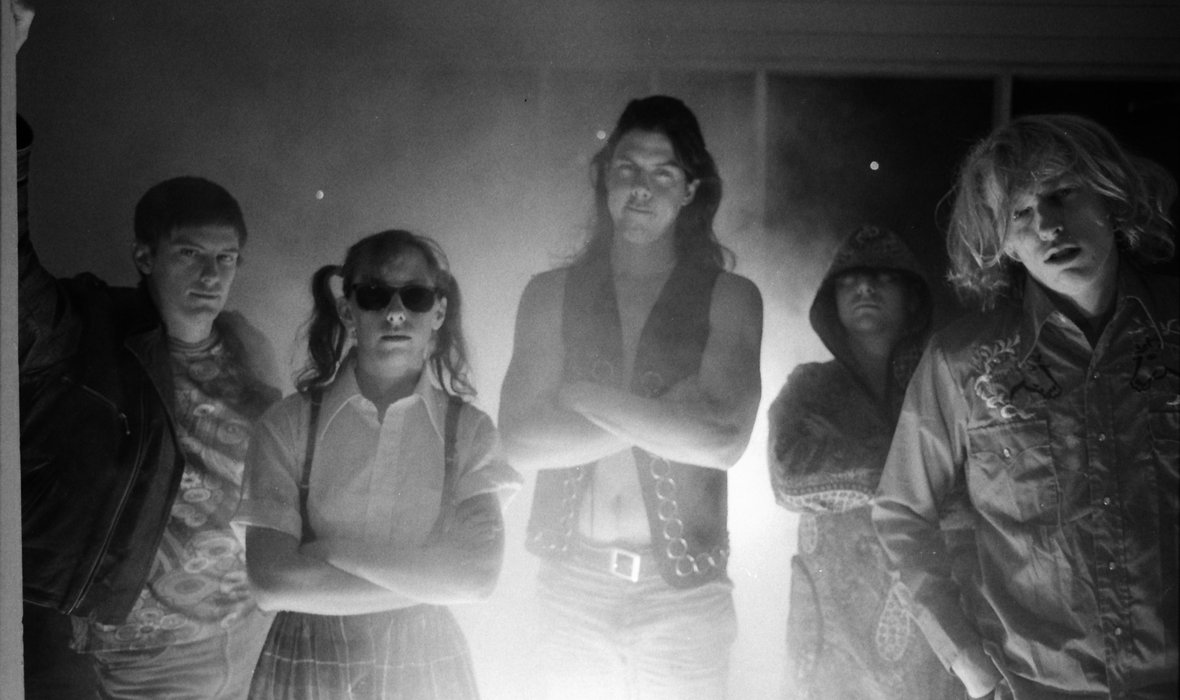

Butthole Surfers: The Hole Truth and Nothing Butt
(USA, 88 min.)
Dir. Tom Stern
A song called “Pepper,” about people dying in tragic mundane ways, may not sound like a traditional chart-topping hit. However, as director Tom Stern makes clear in his documentary Butthole Surfers: The Hole Truth and Nothing Butt, nothing about the titular band was conventional. No matter how far they stretched out their arms, normalcy was always just out of reach.
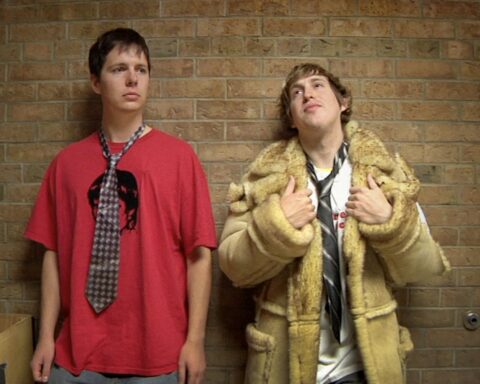
Providing a career spanning look at an unlikely band whose influence still resonates today, Stern’s film opens with bandmates and co-founders Paul Leary and Gibson “Gibby” Haynes reflecting on their first meeting at Trinity University in San Antonio, Texas in the late 1970s. Each future Surfer was studying business at the time, and their career paths to capitalism-fuelled ordinary lives were practically mapped out for them. Despite being polar opposites, Leary was reserved, and Haynes was the extroverted showman, like his actor father, the pair bonded over their shared love for all things art.
Gleefully planting their freak flag on an artistic hill whose peaks seemed endless, the friends tried their hands at everything from making t-shirts to controversial zines. However, music would change their trajectories, as Leary was a great guitarist and Haynes a gifted lyricist. Forming a band, whose name they would change for each show, the duo began to grow a following due to their unique blend of artistic experimentalism and punk rock. Playing small dive bars in the early mid 1980s, and going through a series of bass players, it took eight tries before they landed long-term bassist Jeff Pinkus, the band began to grow a loyal following for their unique live shows.
Part of the Butthole Surfers’ initial appeal was the fact that they had two drummers, King Coffey and Teresa Nervosa, who not only stood while they played, but whose beats were not quite in sync. This trait allowed the band to create a distinct sound to go with their unconventional visuals that ranged from usings images of cockroaches as confetti to ripping apart a stuffed animal on stage and using fans to make the stuffing feel like snow to showing experimental films depicting penis reconstructions. At one point, a young Richard Linklater, the now famed American auteur filmmaker, served as the projectionist for some of their shows.
Constantly pushing the envelope, including playing at queer clubs and even simulating sex on stage at an infamous show in New York, the group seemed to embody everything that went against Leary and Haynes’ conservative Texan upbringing. The fact that Coffey and Nervosa were both openly gay, a point that hits home when the former discusses the pain of not having his marriage considered legal in Texas, further emphasized their defiant progressiveness sense. As Stern’s film documents, the founding members’ home state was not only instrumental in shaping the group, but was a constant presence in their music. It was also the place where the men, especially Haynes, had their own demons that had yet to be dealt with.
Stern highlights the ways Haynes’ past shaped the band’s darker chapters, including his own drug addiction and various antics on and off screen, and the documentary captures how volatile the rock ‘n’ roll lifestyle was for Butthole Surfers. Like a dynamite stick that is one spark on the wick away from igniting, Leary’s temper and Haynes charismatic and controlling traits proved to be a dangerous mixture. Although Stern hints as some of the fallout of this era in the band’s history, including Haynes proximity to, and potential influence on, both actor River Phoenix and musician Kurt Cobain around the times of their respective deaths, the film never goes as deep as it could have.
By travelling so many miles through the band’s story, Butthole Surfers: The Hole Truth and Nothing Butt rarely stops to deeply appreciate any one milestone on the journey. The film plays better as an introduction to the band and their history, rather than a true exploration of what made them tick. One could easily have a whole other documentary just on the various sounds they incorporated on their albums, Leary and or the inner lives of individuals like Coffey, Nervosa, and the band’s go-go dancer Kathleen Lynn, who was also a talented artist.
What is undeniable about Stern’s film, though, is that the group moved to its own rebellious beat. At one point, rapper Ice-T marvelled at the group’s “white boys with guns” Lollapalooza performance, where they had a shotgun and were skeet shooting above the crowd. Whether or not the gun was filled with blanks was not as important as the impact it left. After years on indie labels, they got signed to a major label after that memorable show.
Channelling the band’s sense of artistic flare, Stern’s documentary intertwines plenty of playful visual moments into its conventional structure. Incorporating everything from puppetry, including cheeky puppet nudity, animation, archival photos and videos, the film creates a vibrant collage that gives audiences a sense of the creative genius that the group exhibited with each show and album.
Featuring interviews with not only the band members, but a who’s who of their famous fans including Linklater, John Hawkes, Flea, Eric Andre, Dave Grohl, Dave Ween, and many others, Stern’s film is a loving tribute to a band unlike any other. Butthole Surfers: The Hole Truth and Nothing Butt is a reminder that the most punk thing an artist can do is reject conformity and simply be themselves.