



Perhaps the most daunting task a critic faces is trying to find overriding themes or motifs at a film festival. If it’s a genre festival or one geared to a specific community, then it’s not so bad. However, the Montreal International Documentary Festival / Rencontres internationales du documentaire de Montréal, RIDM for short, tends to render me rudderless. Montreal’s documentary fest is one of the most eclectic film events I’ve attended, anywhere. This year’s edition is no exception: there are docs on racial identity, living off the grid, blueberry farms, and a tribute to Taiwanese docs. It’s a great credit to the programmers that they keep things so open, both thematically and formally. This year sees the return of the popular UXdoc line-up, which features films that blend documentary and fiction, and a tribute to experimental cinema pioneer Louise Bourque.
What follows are reflections on four films featured in the Magnus Isacsson Competition devoted to social impact documentaries. Even in one six-film programming stream, there’s a world of difference.

Les héritiers (The Inheritors)
Having long thought of seagulls as a wildly underrated bird, I was happy to learn that someone had made a documentary about the largest gull colony in Canada, a colony that exists primarily due to a giant landfill near Montreal. Filmmaker Serge-Olivier Rondeau (Resources) introduces us to the landscape with a sweeping 360 degrees panorama of the chilly waterfront where, initially, there are no birds or people. It’s a frosty opener and one that Canadians will recognize instantly. (I felt a compulsion to get my gloves and hat as I heard the droning wind.) A keen moment of observational cinema, it provides a strong sense of the landscape and the elements. It’s such an empty and lonely shot, it approaches the existential.
And then comes an explosion of loud, boisterous gulldom that recalls Hitchcock’s ’63 masterpiece. They’re a breed often considered obnoxious by many due to their squawking, which, when sung by hundreds of birds, is daunting. Rondeau’s camera marvels at the hundreds of birds in his presence as they overwhelm the frame and ultimately the landfill.
My proposed alternate title for this doc is Everything You Always Wanted to Know about Seagulls (But Were Afraid to ask). There are mating rituals, mothers tending to their young, gull-on-gull violence, and the inevitable human interventions. Certain gulls are captured by humans who mark them to allow for observation. The gulls must at times be cleared from the landfill, which requires the use of flares (not always reliable) to the unleashing of a predatory hawk (much more effective).
Les héritiers approaches the sublime when Rondeau slows the camera down ever-so-slightly and shows us hundreds of gulls in flight, reminding us of the beauty and resilience of the ring-billed gull. Despite their large numbers and reputations as bottom-feeders, we’re left in awe and rooting for them.
Green Valley
As an avowed city dweller, Green Valley is definitely taking me into alien territory. Filmmaker Morgan Tams takes a Frederick Wiseman approach, shooting a group of people over a two-year period as they live on a farm almost entirely off the grid. Much of this life is as you’d expect it: people gather food (preparing some of it and freezing others), kids (both human and goat) frolicking in the wilderness, and people explaining how the work/life balance works in a “community-interdependent” existence.
The residents of Green Valley, British Columbia strive to be self-sustaining, running down a shortlist of things they still have to buy and can’t make on their own (coffee, olive oil and some spices). Still, it’s an impressive feat, and their community is clearly a happy one. (Tams is apparently part of this community.)
There’s no sugar-coating, however: we see animals being slaughtered, but are reminded of how much more humane this practice is compared to what creatures face in factory farms. Meanwhile, one young mom relates her occasional frustration at having little or no downtime with two young children in very close proximity.
Tams is clearly celebrating the communal bonds that sustain this group of people. A big part of the ideal is that this is a multi-generational farm, with elders benefitting from having younger people and wee children among them. If there’s a running theme, it comes with the inevitable cycle of life: along with some animals being put down, we meet an elder of the group, Henry, who is grappling with prostate cancer. He knows he won’t be around forever and there are blunt conversations about mortality.
Tams primarily sticks to an observational mode, making the film more poetic than narrative-driven. I was almost disappointed when he chose to introduce some music and to inject the now-obligatory drone shot, both of which interrupt the film’s overall vibe of being down to earth. (Challenge to doc filmmakers: drone shots should be retired for the next decade.)
At a time when we’re constantly being interrupted by notifications on our phones, Green Valley serves as a welcome balm, a reminder that there is indeed an alternative to the non-stop demand for our attention. There’s a sweet moment captured when a birthday is celebrated. A card is read: “Glad to be sharing this weird life with you.” I’m glad Tams shared this weird life with us, too.

Recomposée (A Thousand Colours)
I was slightly reticent after reading the synopsis for Recomposée, seeing as it involves one young biracial woman’s experience as she grapples with her upbringing in a white family, simply because this has become well-worn territory. There’s now enough of such stories to fill a library wing with memoirs written by people with similar journeys, in particular Georgina Lawton’s Raceless and Rebecca Carroll’s Surviving the White Gaze (both from 2021 and highly-recommended reading). The overriding message in these works is that even when adoptive white parents are doing their very best, things can go wrong.
However, first-time filmmaker Nadia Louis-Desmarchais soon wins over any preconceptions with this profound bit of filmmaking, indicating that each person’s journey is unique. Born to a Haitian mom and an Italian-Quebecois dad, she and her siblings were put up for adoption at a young age.
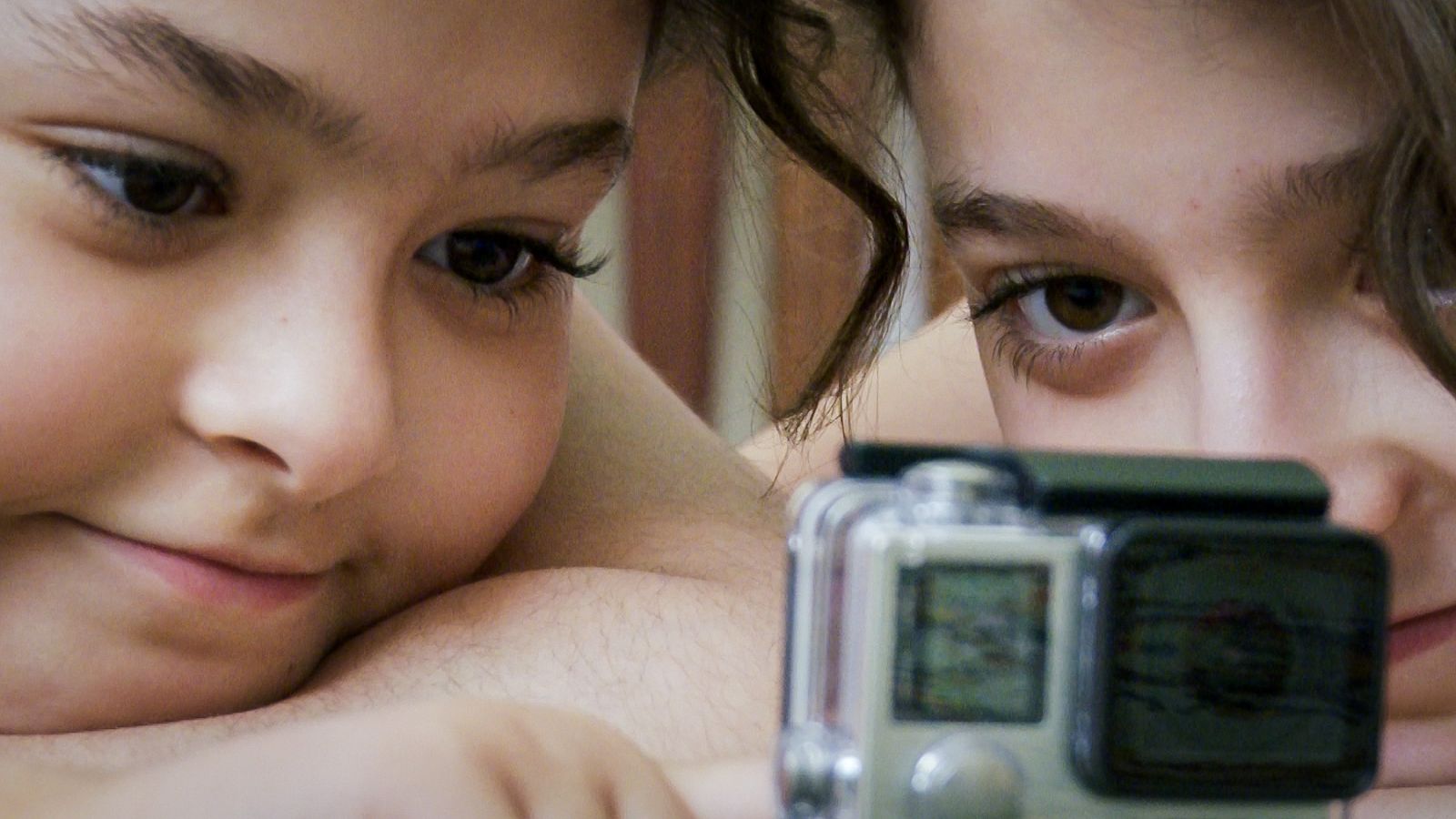
Looking back, she’s grappling with a series of issues that often accompany such arrangements: “Growing up, I didn’t really feel Black,” she recalls. Home movies show a loving family, one Louis-Desmarchais clearly loves but who also didn’t always know what to do with, for example, the curly hair of a Black child. She recalls the physical pain she felt as her mother tried to comb out her curls; and how she felt when she had her hair straightened at an early age.
Louis-Desmarchais’s approach is multi-faceted: she is grappling with the biological parents who abandoned her; she’s processing growing up in a predominantly white household; she’s realizing her own internalized racism; making sense of her identity as biracial; and she’s reuniting with siblings who were adopted into other households.
If there was one scene that left me shattered, it was when Louis-Desmarchais was studying film in college and she and a group of students are watching films about poverty. As one documentary unreels, a woman enters an apartment to join a couple of people, and Louis-Desmarchais realizes the woman she’s watching is in fact her biological mother. Stunned, she gets up to leave the room.
If at times Louis-Desmarchais’s approach seems a bit scattered, the form is part of the message: in a life with so many different identities, some of which are conflicting, things can’t help but be messy. Recomposée is a captivating meditation on race, adoption, identity and family belonging. I’m thankful Louis-Desmarchais had the courage to make it.

The End of the Internet
Amid all of the much-warranted panic about the advent of A.I., something has been lost: we haven’t even grappled with the monumental change and damage the Internet has done to our lives over the past three decades.
In this ambitious documentary, Dylan Reibling attempts to take on this rather epic quandary. The film kicks off with a story worthy of a dystopian sci-fi movie: in 2010, the Nicaraguan government deployed troops to Costa Rica, surmising that Costa Rica had invaded their country. There was no such invasion; the Nicaraguans had made this assumption because Google Maps had incorrectly identified a piece of border territory between the countries as Nicaraguan. (It was, in fact, part of Costa Rica.)
It’s (yet) another reason to lament the near-universal surrender to the Internet, something the vast majority have given up on resisting because, well, you know, efficiency and convenience (plus cat videos).
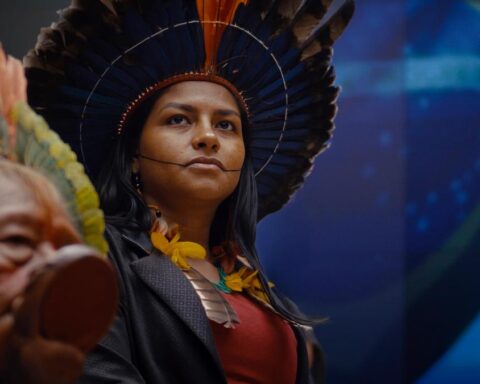
It’s a danger that Reibling is correct to be terrified about, and here he intersperses facts about the early development of the Internet with people who are trying to offer alternatives to the corporate monopolies that now dominate it. People from across the globe (everyone from Indigenous activists in Brazil to someone forced to leave Hong Kong due to the government crackdown there) ponder how something once thought of as so Utopian went so terribly wrong. The Internet was going to enhance democracy and bring in a new age of enlightenment; it would decentralize power; it would be a great equalizer. Spoiler alert: none of that happened.
Reibling shifts between two gears: there are segments that explain how the Internet started and how it evolved (the idea was first hatched at the Rand Corporation, envisioned as a communications system that would continue to work even in the wake of a calamitous event like a nuclear war), and then there’s the globetrotting, in which we meet people who are working to resist and re-imagine the possibilities the Internet might provide.
Can the Internet be de-enshitified? It’s unclear where Reibling stands. While he offers some glimmers of hope, he also poses pointed questions about how damaged some of the people who are creating new visions are; Curtis Yarvin, who was part of a new project called Urbit, has emerged as the latest darling of the nutjob far right, insisting democracy is useless and countries should be run as corporate dictatorships. In one of the film’s most intriguing moments, Reibling asks a former colleague if Urbit’s designs can ever be separated from Yarvin’s toxic, trolling philosophies. The colleague can’t answer.
I can’t say I felt very optimistic after watching The End of the Internet. The title itself is ironic, of course, as Reibling knows it’s far from over. While I appreciate their efforts, it’s highly unlikely the people trying to change it will manage to. Maybe it’s just watching it in the context of our current political climate, but I’m left with the distinct impression that none of this is going to end well.
Also screening in the competition are True North and Spare My Bones, Coyote!.