



Fiume O Morte!
(Croatia/Italy/Slovenia, 112 min.)
Dir. Igor Bezinović
Prod. Vanja Jambrovic, Tibor Keser
The opening number of Fiume O Morte sees director Igor Bezinović play a version of Streets Smarts with people in a city market in Rijeka, Croatia. He asks them if they know who Gabriele D’Annunzio is. Interviewee after interviewee replies with a casual negative. Nobody can identify the name, although one guy thinks he heard it somewhere.
The name Gabriele D’Annunzio, Bezinović notes in voiceover moments before, previously adorned every street, school, and square in Rijeka from about 1919 to whenever they got around to changing the signage following his departure in 1921. Eventually, the filmmaker stumbles upon a citizen whose wife volunteers him to answer and says he works for a museum, so he’ll probably know. He identifies D’Annunzio as a fascist who controlled the area formally known as Fiume.
It turns out that Croatians actually do know the name. They just wish they didn’t. Nobody has anything nice to say about the man who occupied their city decades ago. People in Rijeka don’t have much time for fascists. “They’re still around today,” one woman admits. “Unfortunately, we just don’t know who they are.”
Fiumo O Morte, Croatia’s official submission for Best International Feature in this year’s Oscar race, playfully ferrets out some fascists, at least in spirit, by inviting residents of Rijeka to recreate a historically farcical, or farcically historical, account of D’Annunzio’s occupation. Overall, the townspeople have little to worry about. Even though they’ve gladly forgotten D’Annunzio’s name, the implications of his occupation haven’t been lost to historical memory.
What ensues is an ingenious reclamation of place and history. Bezinović recaps D’Annunzio’s relatively quick and extremely chaotic rise to power. He narrates the odd tale of the Italian-born man whose early career as a poet, novelist, and playwright, ascended to political ambitions in the aftermath of the First World War.
As Bezinović passes the voiceover baton and invites other Rijekans to tell the story, Fiume O Morte illuminates D’Annunzio’s relatively obscure siege on the 28 square kilometre piece of land on the Adriatic Sea. The political significance of Fiume mostly relates to contested territory in the aftermath of WWI. The land, the narrator explains, represents a site of struggle for an autocratic Italian who, well, was looking for something to do. The film tells of a local debate as Fiume’s temporary governing body, the Italian National Council, weighed the choices of joining the new Kingdom of Yugoslavia, jumping ship for Italy, or being an autonomous state. The waffling and political bellyflops set the terrain for D’Annunzio to essentially roll into town in 1919 and run the show for 15 months.
Fiume O Morte conveys the rag tag nature of D’Annunzio’s reign of terror with a light touch. A swing-style score undercuts all the self-seriousness of the limited historical records that exist. Bezinović notes in voiceover that D’Annunzio had thousands of portraits taken by his photographer, which serve as a historical record of sorts for the era. Although the shots mostly evoke hack propaganda photography as the portraits elevate the Commandante and his group of merry men, which dwindles as the years go on.
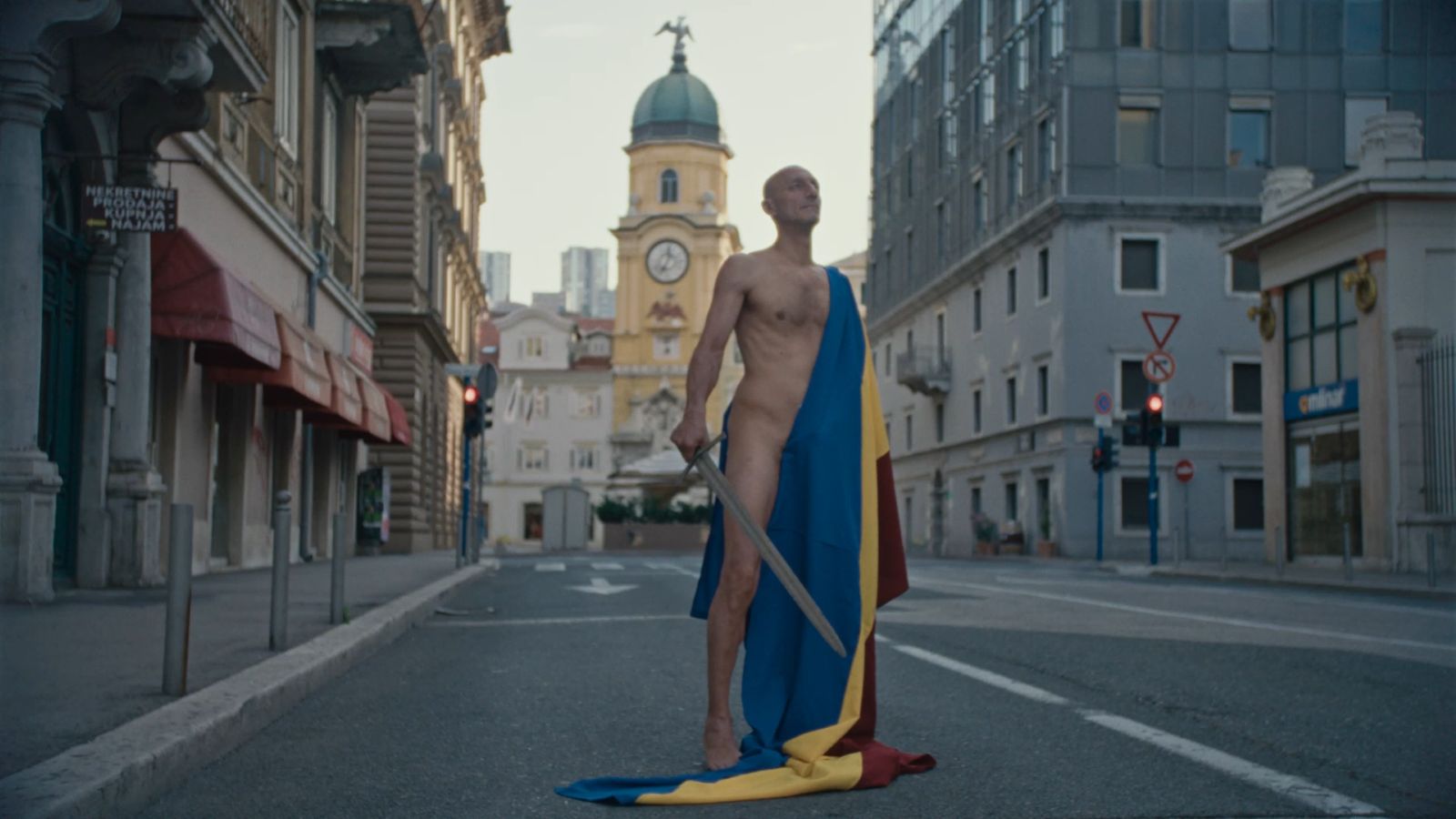
Bezinović embraces the gaps in the historical record, though, as the present-day citizens stage the scene. A game ensemble of bald men takes turns playing D’Annunzio with various interpretations ranging from stoic to parodic. Sometimes these dramatizations see contemporary figures restage portraits and photographs with Bezinović’s direction accentuating the absurd humour of D’Annunzio’s efforts to inflate his image. These include a portrait of the man nude in the streets, wearing only a flag like a toga, or shots of the infantry frolicking at the beach. They’re not the most threatening army. However, the committed performances by the locals all take ownership of this history with confidence and artistic vision. One really sees how this exercise empowers them when D’Annunzio and his minions sought to oppress their elders.
The film revisits some of the fascist’s favourite haunts too, and reimagines history in the contemporary settings. These include a random flat where D’Annunzio stayed for the night during a road trip. The current resident, Antonia, happily rotates her bed, moves her nightstand, and places a chamber pot on the floor to more or less recreate a photograph from the era.
Likewise, Bezinović tracks down D’Annunzio’s favourite tavern, which now hosts a nail salon. Its proprietor gamely lets another actor, “the most fun loving of our bald men,” as the narrator calls him, restage the salon while playing the fascist to recreate one of D’Annunzio’s nights fuelled by booze and coke. His friend, political agitator Guido Keller, gifts him a stuffed platypus stolen from the local museum. Keller then advises him that Fiumo needs more evidence of individual violence and massacres. So begins the downward spiral, proving that there’s always somewhere down to go.
While Bezinović plays fast and loose with form, he ensures that the historical record remains experientially and subjectively true. Stories from the contemporary Rijekans pepper the narrative as they insert their histories into the tale. They write their history anew like a fresh coat of paint.
Photographs, facsimiles, reconstructions, and interpretations are all records of sorts. He conveys how they capture similar essences in the opening scene as he holds a photograph of a bridge before D’Annuzio blew it up. He replaces that archival photo with a shot of debris following the explosion, another of the replacement bridge, and then a hand-drawn portrait of the bridge. They’re all essentially the same structure. And with the images held atop the present-day bridge from various angles, they’re all pretty accurate. More or less.
Fiumo O Morte observes the ephemeral nature of history’s villains as it tours a city that’s generally painted over D’Annunzio’s memory. Streets and squares have new names, while old murals hide behind fresh coats. Bridges have been rebuilt and residents near former borders have since reclaimed his stones for their gardens. People in Rijeka barely say his name because he isn’t worth talking about. However, given the obvious contemporary resonance of a people ruled by a tyrannical ignoramus, Fiume O Morte also evokes the danger of forgetting history—as much as we’d sometimes like to.